
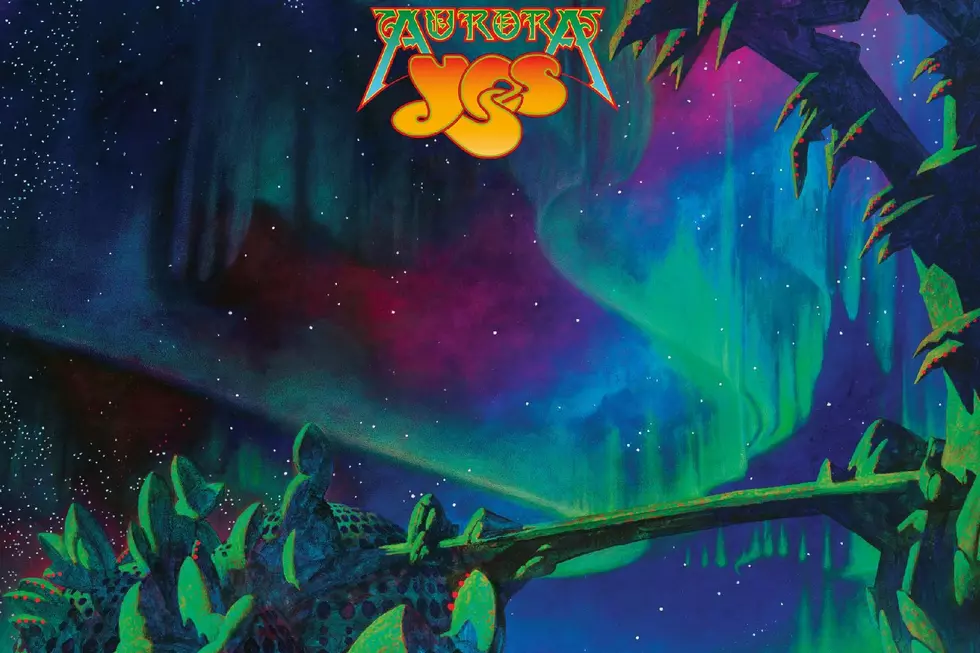
Yes’ Third Album in Five Years: ‘Aurora’ Review
Legacy bands must straddle a line between the musical approach that originally brought them to fame and trying something new. With some fans, either choice – if made outright – dooms the latest release. But what of bands that undergo radical lineup changes over the years? Are they still beholden to what came before? And what of those that emerge with no remaining original members? Are they doomed to a life of caricature?
That’s Yes’ basic conundrum. They never had a lineup for longer than two consecutive albums. Well, until now. The current grouping of Steve Howe, Geoff Downes, Jon Davison, Billy Sherwood and Jay Schellen has lasted longer than any other. Aurora is their third album together, though the late Alan White also appeared on 2021’s The Quest.
An entirely unexpected period of stability has offered the modern-day edition of Yes a chance to reckon with the heavy musical baggage that they’ve inherited. Each new studio project, culminating with Aurora, has represented another step out of those long shadows toward a musical approach that’s now wholly their own.
READ MORE: Prog Rock’s 50 Best Albums
This is no longer a group trying to conjure the glories of years past, to reanimate the career-defining early-‘70s period when Howe first joined. Yes has also stopped chasing the sugar rush of their ‘80s hitmaking era, when Howe had shifted over to Asia after completing 1980’s Drama with Downes. Instead, they are a group of players with three notable links ot the past – Sherwood had an earlier tenure in the ’90s – who have finally discovered their own point of view.
Of course, whispers of the past remain. It’s to be expected considering this shared heritage. The lyrics for the title track were inspired by Paramahansa Yogananda’s Autobiography of a Yogi, which in turn served as a partial inspiration for 1973’s Tales from Topographic Oceans. There’s a multi-chapter centerpiece song, “Countermovement,” though thankfully nothing on the order of the meandering side-long tracks from Tales.

“Outside the Box” boasts an early acapella interplay that recalls 1983’s “Leave It.” “Jambustin,’” one of the bonus tracks, playfully references 1978’s “Don’t Kill the Whale.” There are even nods to more recent history, as the opening moments of Aurora mimic the initial swelling ruminations on cosmic manifestation found on “Cut From the Stars” on 2023's Mirror to the Sky. But playing for so long together, often in service of full-length performances of Yes’ most treasured albums, has allowed this lineup to think beyond the expected hat-tips to the catalog.
Aurora extends the Yes story but not by providing an echo. They’re using all that came before as a foundation to evolve into their true selves. Davison has come into his own as a vocalist, even setting aside his typically very Jon Anderson-like vocal approach to explore a lower register in “All Hands on Deck.” (He also appears as many times in the songwriting credits on Aurora as Howe, who again serves as producer.)
How 'Aurora' Differs From More Recent Yes Albums
Downes’ keyboards (finally) move higher into the mix, including a smattering of brawny, Deep Purple-esque organ. Shellen earns his first composer acknowledgements, including a section of “Countermovement” that features the crafty phrase “in the blink of an AI.” Sherwood adds some key songwriting elements and pops up vocally in the most interesting of ways on the mythologically influenced “Ariadne,” but never plays bass as forcefully as his mentor, the late Chris Squire. That fits this version of Yes, too.
There’s likewise a sense of community that wasn’t always there with The Quest and Mirror to the Sky. It’s clear they spent more time in the room together, rather than simply sharing files. Long-time artistic collaborator Roger Dean's bridge-themed album cover couldn’t be more perfect. Leading all of this, somehow, is the longest-tenured, eldest member of the band.
READ MORE: Top 10 Yes Songs of the '70s
Howe again serves as the fully engaged late-period soundboard, notably stitching together this LP’s signature extended prog moment while adding perhaps his best-ever vocal (the “Anytime Soon” section of “Countermovement,” which appears to have been quite appropriately inspired by Bob Dylan). Howe thrillingly expands from the expected acoustic, steel and electric guitar to add Variax sitar guitar (“Aurora,” “Countermovement: Blink of an Eye,” “All Hands on Deck”) and Portuguese 12-string (“Watching the River Roll”), too.
Even amid the winter of a storied career, Howe seems to be having a rangy new kind of fun. In an interview with Now Spinning, Davison said: “Steve always works under this one banner, which is: Yes doesn’t follow rules.” Including, on Aurora, their own.
Revisiting Yes’ First LP Without Chris Squire
